第二讲 零基础入门(二)
认识原理图
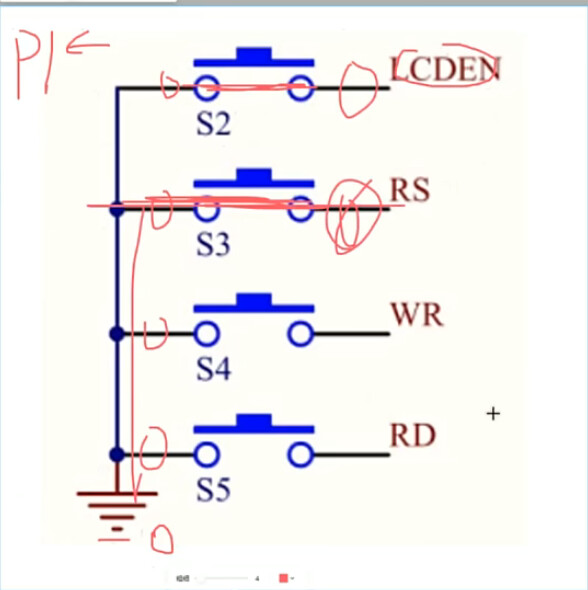
左侧接地,电平为0,如果按键按下,右侧引脚电平也是0
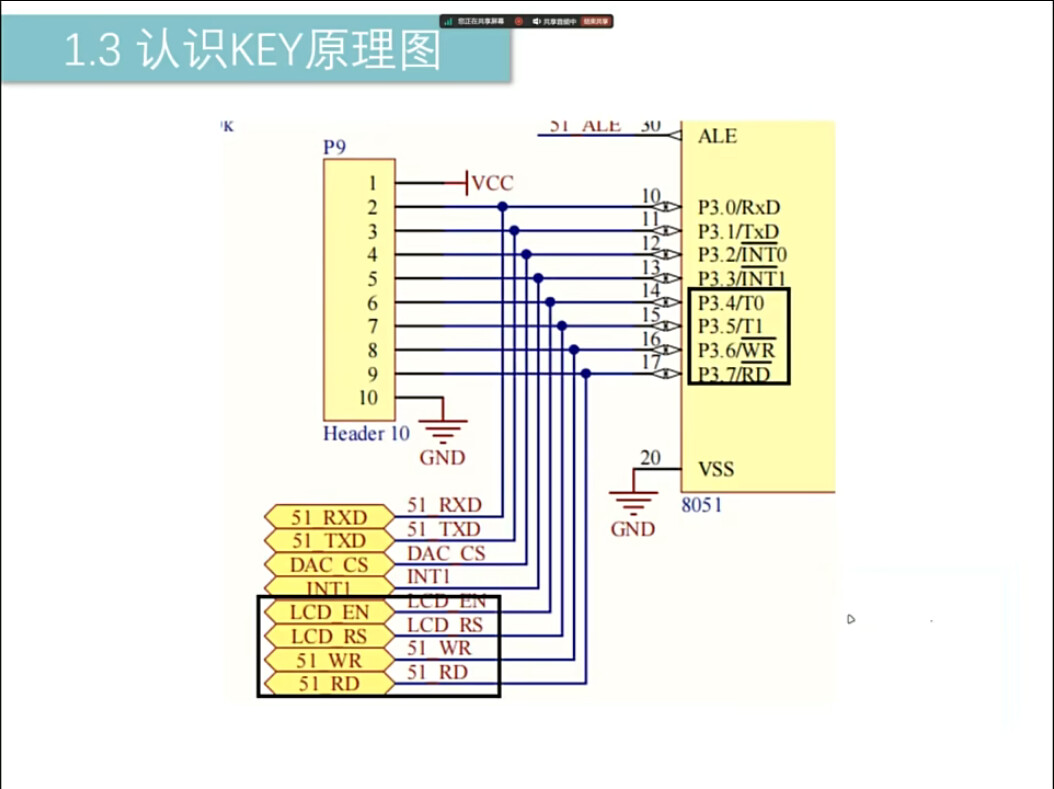
引脚接的是IO口P34到P37,检测按键是否按下,就是在检测对应的IO口是否为0
用按键控制LED的亮灭
#include <stdio.h>
#include <REGX52.H>

/*变量声明区域*/
unsigned char Key_Val,Key_Down,Key_Up,Key_Old;

/*按键读取函数*/
unsigned char Key_Read()
{
	unsigned char temp=0;
	if(P3_4==0) temp=1;
	if(P3_5==0) temp=2;
	if(P3_6==0) temp=3;
	if(P3_7==0) temp=4;
	return temp;
}

void main ()
{
while(1)
{
	Key_Val=Key_Read();//读取键码值
	Key_Down=Key_Val&(Key_Val^Key_Old);//检测下降沿
	Key_Up=~Key_Val&(Key_Val^Key_Old);//检测上升沿
	Key_Old=Key_Val;//扫描辅助变量
	if(Key_Down==1)
		P1_0=0;
	if(Key_Up==2)
		P1_0=1;
	if(Key_Old==3)
		P1_1=0;
	else
		P1_1=1;
}

}
其中Key_Down代表按键按下 Key_Up代表按键松开 Key_Old代表一直按着
用按键控制流水灯的开始和暂停
#include <stdio.h>
#include <REGX52.H>
#include <intrins.h>
/*变量声明区域*/
unsigned char Key_Val,Key_Down,Key_Up,Key_Old;
unsigned char ucLed=0xfe;
bit System_Flag;

/*延时函数*/
void Delay(unsigned char xms)	//@12.000MHz
{
	while(xms--)
	{
		unsigned char data i, j;

	i = 2;
	j = 239;
	do
	{
		while (--j);
	} while (--i);
}
}
/*按键读取函数*/
unsigned char Key_Read()
{
	unsigned char temp=0;
	if(P3_4==0) temp=1;
	if(P3_5==0) temp=2;
	if(P3_6==0) temp=3;
	if(P3_7==0) temp=4;
	return temp;
}

void main ()
{
while(1)
{
	Key_Val=Key_Read();//读取键码值
	Key_Down=Key_Val&(Key_Val^Key_Old);//检测下降沿
	Key_Up=~Key_Val&(Key_Val^Key_Old);//检测上升沿
	Key_Old=Key_Val;//扫描辅助变量
	if(System_Flag==1)
		{
	ucLed=_crol_(ucLed,1);
	P1=ucLed;
	Delay(100);
	}
	if(Key_Down==1)
		System_Flag=1;
	if(Key_Down==2)
		System_Flag=0;
}
}
优化代码
#include <stdio.h>
#include <REGX52.H>
#include <intrins.h>
/*变量声明区域*/
unsigned char Key_Val,Key_Down,Key_Up,Key_Old;
unsigned char ucLed=0xfe;
bit System_Flag;

/*延时函数*/
void Delay(unsigned char xms)	//@12.000MHz
{
	while(xms--)
	{
		unsigned char data i, j;

	i = 2;
	j = 239;
	do
	{
		while (--j);
	} while (--i);
}
}
/*按键读取函数*/
unsigned char Key_Read()
{
	unsigned char temp=0;
	if(P3_4==0) temp=1;
	if(P3_5==0) temp=2;
	if(P3_6==0) temp=3;
	if(P3_7==0) temp=4;
	return temp;
}

void main ()
{
while(1)
{
	Key_Val=Key_Read();//读取键码值
	Key_Down=Key_Val&(Key_Val^Key_Old);//检测下降沿
	Key_Up=~Key_Val&(Key_Val^Key_Old);//检测上升沿
	Key_Old=Key_Val;//扫描辅助变量
	if(System_Flag==1)
		{
	ucLed=_crol_(ucLed,1);
	P1=ucLed;
	Delay(100);
	}
	switch(Key_Down)
	{
		case 1:
			System_Flag=1;
			break;
		case 2:
		System_Flag=0;
		break;
	}
}
}
矩阵键盘
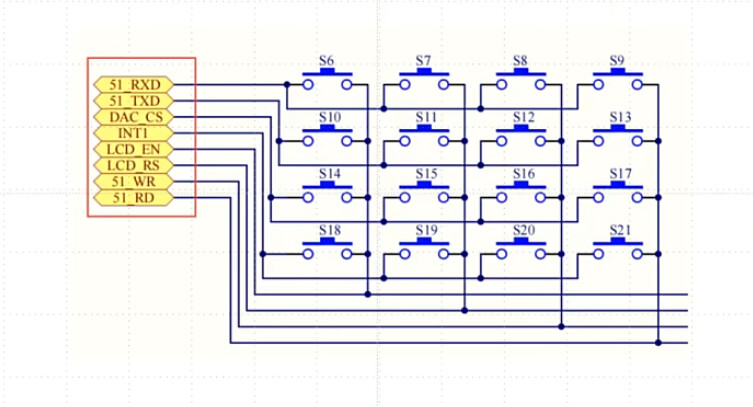
本质上是先选择行,再选择列
 #include <stdio.h>
#include <REGX52.H>
#include <intrins.h>
/*变量声明区域*/
unsigned char Key_Val,Key_Down,Key_Up,Key_Old;
unsigned char ucLed=0xfe;
bit System_Flag;

/*延时函数*/
void Delay(unsigned char xms)	//@12.000MHz
{
	while(xms--)
	{
		unsigned char data i, j;

	i = 2;
	j = 239;
	do
	{
		while (--j);
	} while (--i);
}
}
/*按键读取函数*/
unsigned char Key_Read()
{
	unsigned char temp=0;
	P3_0=0;P3_1=1;P3_2=1;P3_3=1;
	if(P3_4==0) temp=1;
	if(P3_5==0) temp=2;
	if(P3_6==0) temp=3;
	if(P3_7==0) temp=4;
	P3_0=1;P3_1=0;P3_2=1;P3_3=1;
	if(P3_4==0) temp=5;
	if(P3_5==0) temp=6;
	if(P3_6==0) temp=7;
	if(P3_7==0) temp=8;
	P3_0=1;P3_1=1;P3_2=0;P3_3=1;
	if(P3_4==0) temp=9;
	if(P3_5==0) temp=10;
	if(P3_6==0) temp=11;
	if(P3_7==0) temp=12;
	P3_0=1;P3_1=1;P3_2=1;P3_3=0;
	if(P3_4==0) temp=13;
	if(P3_5==0) temp=14;
	if(P3_6==0) temp=15;
	if(P3_7==0) temp=16;
	return temp;
}

void main ()
{
while(1)
{
	Key_Val=Key_Read();//读取键码值
	Key_Down=Key_Val&(Key_Val^Key_Old);//检测下降沿
	Key_Up=~Key_Val&(Key_Val^Key_Old);//检测上升沿
	Key_Old=Key_Val;//扫描辅助变量
	if(System_Flag==1)
		{
	ucLed=_crol_(ucLed,1);
	P1=ucLed;
	Delay(100);
	}
	switch(Key_Down)
	{
		case 1:
			System_Flag=1;
			break;
		case 2:
		System_Flag=0;
		break;
	}
}
}
用矩阵键盘实现对流水灯的控制
用矩阵键盘实现对流水灯的控制和加减速
#include <stdio.h>
#include <REGX52.H>
#include <intrins.h>
/*变量声明区域*/
unsigned char Key_Val,Key_Down,Key_Up,Key_Old;
unsigned char ucLed=0xfe;
unsigned int Time=500;
bit System_Flag;

/*延时函数*/
void Delay(unsigned char xms)	//@12.000MHz
{
	while(xms--)
	{
		unsigned char data i, j;

	i = 2;
	j = 239;
	do
	{
		while (--j);
	} while (--i);
}
}
/*按键读取函数*/
unsigned char Key_Read()
{
	unsigned char temp=0;
	P3_0=0;P3_1=1;P3_2=1;P3_3=1;
	if(P3_4==0) temp=1;
	if(P3_5==0) temp=2;
	if(P3_6==0) temp=3;
	if(P3_7==0) temp=4;
	P3_0=1;P3_1=0;P3_2=1;P3_3=1;
	if(P3_4==0) temp=5;
	if(P3_5==0) temp=6;
	if(P3_6==0) temp=7;
	if(P3_7==0) temp=8;
	P3_0=1;P3_1=1;P3_2=0;P3_3=1;
	if(P3_4==0) temp=9;
	if(P3_5==0) temp=10;
	if(P3_6==0) temp=11;
	if(P3_7==0) temp=12;
	P3_0=1;P3_1=1;P3_2=1;P3_3=0;
	if(P3_4==0) temp=13;
	if(P3_5==0) temp=14;
	if(P3_6==0) temp=15;
	if(P3_7==0) temp=16;
	return temp;
}

void main ()
{
while(1)
{
	Key_Val=Key_Read();//读取键码值
	Key_Down=Key_Val&(Key_Val^Key_Old);//检测下降沿
	Key_Up=~Key_Val&(Key_Val^Key_Old);//检测上升沿
	Key_Old=Key_Val;//扫描辅助变量
	if(System_Flag==1)
		{
	ucLed=_crol_(ucLed,1);
	P1=ucLed;
	Delay(Time);
	}
	switch(Key_Down)
	{
		case 1:
			System_Flag=1;
			break;
		case 2:
		System_Flag=0;
		break;
		case 3:
			Time+=100;
		break;
		case 4:
			Time-=100;
		break;
	}
}
}